.webp)
Dumb Ways to Build: How to Survive a Construction Site That Hates You
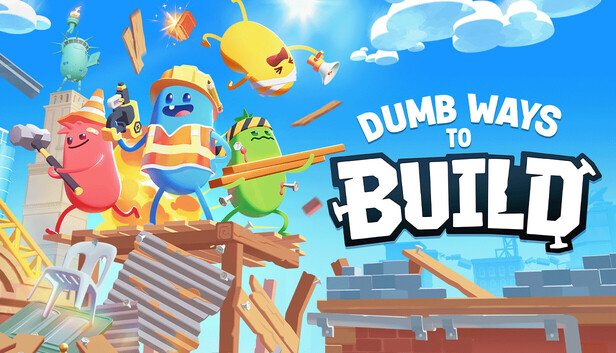
In most construction games, building is supposed to be satisfying. You place the right pieces, follow the plan, finish the structure, and admire what you created.
Dumb Ways to Build has a very different philosophy.
Here, building is only half the problem. The other half is surviving the consequences.
Created by the team behind Dumb Ways to Die, Dumb Ways to Build is a chaotic physics-based co-op game where up to four players work together to construct platforms, overcome dangerous obstacles, and escape hazardous jobsites. You have a collection of construction tools, makeshift materials, and physics-driven equipment—but nothing guarantees that your brilliant plan will stay brilliant for more than five seconds.
The game is built around a simple question:
Can your crew build a way forward before the jobsite finds a way to destroy you?
The trick is not becoming a perfect builder. It is learning how to improvise when your perfectly reasonable plan suddenly becomes extremely unreasonable.

1. Build the Route, Not Just the Platform
The first instinct in Dumb Ways to Build is to look at an obstacle and ask:
“What can I build here?”
A better question is:
“How are we getting across this entire section?”
The game is designed around DIY platforming, meaning your crew needs to construct its own path through dangerous environments.
That means one platform should rarely be considered as an isolated object.
Think Three Steps Ahead
Before placing anything, identify:
- Where the team is standing now.
- Where the next safe position is.
- Where the route needs to continue afterward.
A platform that reaches the next ledge might look perfect until you realize there is nowhere safe to stand after landing.
Build for the Next Mistake
Your route should have room for imperfect movement.
If a teammate misses the center of a platform, can they recover?
If someone drops a tool, can another player reach them?
If the structure moves unexpectedly, is there another path?
The strongest construction is not always the shortest one.
It is the one that still works when something inevitably goes wrong.
2. Treat Physics Like a Teammate You Can't Trust
The construction tools in Dumb Ways to Build are physics-based, meaning objects can behave in ways that help your crew—or completely derail the plan.
That unpredictability is not simply a problem.
It is one of the game's biggest opportunities.
Test Before You Commit
When using an unfamiliar tool or building material, do not immediately create the most ambitious structure possible.
Start small.
Place something.
Watch how it moves.
Then decide how to use it.
You are essentially learning the personality of the physics system.
Remember: The Environment Is Part of the Build
A construction piece may behave differently depending on:
- Its position.
- Its angle.
- What it touches.
- How much weight is placed on it.
- What happens around it.
This means experimentation can sometimes reveal a clever solution that a straightforward build would never produce.
And occasionally, the completely ridiculous solution is the one that works.

3. Give Every Player a Construction Role
Co-op becomes much easier when four players are not all trying to do exactly the same thing.
The official game supports online co-op for one to four players, while also allowing players to attempt the jobs alone.
A coordinated crew can divide responsibilities even though the game does not force you into formal classes.
Try the Four-Role Method
The Builder
Focuses on placing and assembling the main structure.
The Scout
Moves ahead to identify the next obstacle and possible route.
The Carrier
Manages useful tools and materials so the team does not constantly stop to retrieve them.
The Safety Officer
Watches what everyone else is doing and notices when the construction is about to become catastrophically stupid.
The last role may sound unnecessary.
It absolutely is not.
Avoid the “Everyone Build at Once” Problem
Four players simultaneously grabbing objects can turn a simple section into complete chaos.
Instead, decide who is responsible for the next action.
One player builds.
One player stabilizes or assists.
The others prepare for what comes next.
The less time your team spends fighting over the same object, the more time it has to deal with the actual level.
4. Don't Build the Perfect Structure—Build the Fastest Safe One
There is a dangerous mindset in construction games:
“It needs to look right.”
In Dumb Ways to Build, appearance is usually much less important than survival.
The official description emphasizes solving deadly challenges with teamwork and clever tool usage, rather than constructing elegant or realistic structures.
So your objective should be functional.
Use the Minimum Necessary
When facing an obstacle, ask:
Can one piece solve this?
If yes, try one.
If not, add another.
This keeps the construction simple and reduces the number of things that can go wrong.
Avoid Unnecessary Engineering
A complicated structure creates more opportunities for:
- Misalignment.
- Physics problems.
- Players getting in each other's way.
- Accidental destruction.
- Losing valuable time.
In a chaotic jobsite, simple engineering is often better engineering.
5. Your Toolbelt Is a Box of Solutions, Not a Collection of Gadgets
One of the game's defining features is its physics-based arsenal of construction tools, strange consumables, and makeshift building materials.
The important part is learning when to use each tool.
A tool that seems useless in one situation might become the perfect answer somewhere else.
Build a Mental Tool Dictionary
As you play, start mentally categorizing your equipment:
Movement tools
Help the crew reach places they normally cannot.
Construction tools
Create or manipulate the path forward.
Problem-solving tools
Handle obstacles that cannot be solved through ordinary building.
Emergency tools
Become useful when everything has already gone wrong.
That last category is especially important.
Save Something for the Disaster
Do not spend every useful item simply because it is available.
A jobsite can change in seconds.
Keeping one emergency option can turn:
“We are doomed.”
into:
“That was absolutely intentional.”
6. Communication Is More Important Than Mechanical Skill
A four-player construction crew can have excellent individual players and still fail because nobody knows what anyone else is doing.
That is why Dumb Ways to Build includes proximity chat as one of its features. It allows teammates to coordinate—or simply hear each other panic when another disastrous construction accident happens.
Use Short Calls
Instead of explaining everything, establish simple communication:
“Hold.”
Do not touch the structure.
“Build.”
Place the next piece.
“Jump.”
Move now.
“Back.”
The current position is unsafe.
“Leave it.”
Do not attempt to recover the object.
Short communication becomes extremely useful when physics starts moving faster than conversation.
Speak Before the Disaster
The best communication happens before something goes wrong.
Tell teammates what you are planning before you build it.
For example:
“I'm making a bridge to the left. Nobody stand on it yet.”
That five-second warning can prevent an entire structure from collapsing.

7. In Solo Play, Slow Down the Chaos
Although the game is designed with up to four-player co-op in mind, it can also be played entirely solo. Solo play includes a useful mechanic that allows players to temporarily freeze objects in mid-air, making certain construction tasks easier without teammates.
This changes the rhythm of the game.
When playing alone, there is no reason to imitate a four-player team's speed.
Use the Pause in Physics
Take advantage of the extra control to:
- Position objects more precisely.
- Experiment with unusual solutions.
- Set up difficult structures before moving.
- Reduce accidental movement.
- Think about the next step instead of reacting constantly.
Solo play is less about replacing four players and more about giving yourself enough control to solve the same problems differently.
Think Like an Engineer
When no teammate is available, every action matters.
Rather than improvising every second, create a sequence:
Observe → Position → Build → Test → Move
This turns a chaotic job into a manageable puzzle.
8. Expect the Jobsite to Punish Overconfidence
The game describes its missions as hazard-filled “Crisis Jobs,” with each job offering different dangers and requiring teamwork and clever tool usage.
This means surviving one obstacle does not mean the level is safe.
The next problem may require a completely different response.
Never Assume the Previous Solution Still Works
A strategy that worked perfectly five minutes ago may fail because:
- The environment changed.
- The next hazard behaves differently.
- Your structure needs a different shape.
- The team approaches from another angle.
Adaptation is more valuable than memorizing a single trick.
Watch for the Calm Moments
The moments where nothing seems to be happening are often when you should prepare.
Check:
- Who has the necessary tools.
- Where everyone is standing.
- What the next objective is.
- Whether your current structure is actually secure.
A few seconds of preparation can prevent several minutes of disaster recovery.
9. When Something Goes Wrong, Don't Immediately Restart
A construction failure can feel catastrophic.
A platform collapses.
Someone falls.
A tool disappears somewhere impossible.
The entire team starts shouting.
And then someone says:
“Restart.”
Wait.
The official game is built around chaotic problem-solving, so mistakes are part of the intended experience rather than something that must always be avoided.
Turn Failure Into Information
When a structure fails, ask:
Why?
Was it too heavy?
Poorly positioned?
Used at the wrong angle?
Was someone standing on it too early?
Was there a safer route?
That answer is more valuable than simply repeating the same construction.
Use the “Change One Thing” Rule
On the next attempt, change one major decision.
If it works, you know what caused the improvement.
If it fails again, you have learned something else.
Eventually, the job becomes less about luck and more about understanding how the environment behaves.
10. Become a Master Builder by Making Chaos Predictable
Once you understand the tools, routes, and hazards, the game introduces a higher challenge through Master Builder difficulty, where mastered jobs return with enhanced difficulty and new challenges.
This is where improvisation starts turning into mastery.
Don't Try to Be Faster Everywhere
A common mistake in higher difficulty is attempting to rush every section.
Instead, identify where speed actually matters.
Move quickly through familiar areas.
Slow down at sections where failure is expensive.
Prepare before complicated construction.
Then accelerate again.
Create Your Crew's Own Rules
A strong team can develop its own habits:
- Only one player touches the main structure at a time.
- The scout always moves ahead.
- Everyone announces before moving a critical object.
- The team keeps one emergency tool available.
- Failed structures are analyzed before rebuilding.
These rules may sound overly serious for a game called Dumb Ways to Build.
That is exactly why they work.
The more organized the crew becomes, the funnier it is when everything still goes completely wrong.

Conclusion: The Dumbest Construction Can Be the Smartest Solution
Dumb Ways to Build is not really about constructing perfect buildings.
It is about solving impossible-looking problems with whatever happens to be in your toolbelt while your friends are trying to keep the entire plan from collapsing.
The physics can betray you. Your teammates can accidentally make things worse. A carefully designed platform can become a disaster in seconds. But those failures are also where the game's personality comes from. Its combination of DIY platforming, hazardous jobs, physics-based tools, co-op communication, and unpredictable construction creates an experience where improvisation matters just as much as planning.
So do not enter every jobsite looking for the perfect blueprint.
Enter with a rough plan, a few useful tools, a crew that communicates, and enough confidence to try something ridiculous.
Because in Dumb Ways to Build, the question is rarely:
“Can we build this properly?”
It is:
“Can we build something that works before it kills us?”